Scaling Up: Choosing the Right Commercial Water Tanks for Your Nairobi Business or Factory
If you run a thriving business in Kenya—be it a busy hospital, a bustling school, a manufacturing plant in Athi River, or a large apartment complex in Westlands—you know that water security isn't a luxury; it’s the backbone of operations. When the municipal supply falters (which, let’s be honest, it often does), having insufficient storage capacity can bring production to a grinding halt, compromise hygiene standards, or even risk patient safety.
Moving from a standard 1,000-litre household tank to a commercial-grade solution requires a completely different approach. You need durability, compliance, and massive capacity. Here at Restore Services, we guide Kenyan businesses through this complex decision every day. Let’s look at what it takes to invest wisely in commercial and industrial water storage.
Why Standard Tanks Won't Cut It for Commercial Use
Many business owners make the mistake of simply multiplying their household needs. A family of five might manage with a 5,000-litre tank. But consider a 50-bed clinic or a mid-sized garment factory. Their daily water usage is exponentially higher, factoring in sanitation, production processes, cooling systems, and staff needs. Running out during peak hours means lost revenue and serious operational headaches.
The Load Factor: Weight and Structural Integrity
Capacity is only half the battle. Water is heavy—one cubic meter (1,000 litres) weighs a full tonne (1,000 kg). A 10,000-litre tank weighs 10 tonnes when full. Can your existing rooftop or ground space handle that static load? In Nairobi’s high-density areas, rooftop installations require expert structural assessment. Concrete slabs designed for residential loads often cannot safely support industrial-scale storage.
Action Point: Before ordering a massive tank, consult a structural engineer. If ground space is limited, we often recommend robust, specialized steel or GRP (Glass Reinforced Plastic) tanks designed for elevated platforms, which distribute the load more efficiently than standard polyethylene models.
Sizing Your Industrial Water Storage Needs in Kenya
Determining the right size isn't guesswork; it’s calculation based on your usage pattern and supply reliability. Here are the key factors to consider:
- Peak Demand: What is the maximum water you use in a 24-hour period? (e.g., laundry cycles, lunchtime rush, continuous cooling in a factory setting).
- Autonomy Period: How long must your system operate without external replenishment? In areas with scheduled water rationing, businesses often aim for 3 to 5 days of reserve capacity.
- Water Source Reliability: If you rely solely on sporadic municipal supply, you need a larger buffer. If you have borehole access, your required reserve might be smaller, focusing more on daytime peak balancing.
For large commercial facilities, we often recommend a minimum of 1.5 times the average daily usage as a safety buffer. For critical operations like hospitals, this buffer should cover at least 48 hours of continuous operation.
Commercial Tank Types and Materials Comparison
While domestic users often stick to standard LLDPE tanks, commercial applications demand materials built for longevity under high stress and large volumes. Here is a quick comparison:
| Material | Typical Capacity Range (L) | Pros for Commercial Use | Cons |
|---|---|---|---|
| Heavy-Duty Polyethylene (HDPE/LLDPE) | 5,000L – 20,000L | Corrosion-resistant, relatively lightweight, good cost-to-capacity ratio. | Can deform under extreme height/pressure; UV degradation over very long terms. |
| Fiberglass (GRP/FRP) | 10,000L – 100,000L+ | Excellent strength-to-weight ratio, highly durable, customisable shapes. | Higher initial cost, requires specialized installation teams. |
| Steel (Galvanized or Lined) | 20,000L – Millions of Litres | Maximum longevity, suitable for very large volumes, often preferred for fire suppression reserves. | Requires protective internal lining, potential for rust if lining fails, very heavy foundation needed. |
Need expert advice on which material suits your operational budget and space constraints in Mombasa or Kisumu? Restore Services offers free site consultations to assess your specific commercial requirements. Contact us today to schedule an assessment!
Compliance: Meeting KEBS Standards for Commercial Water Storage
In Kenya, especially for businesses handling public health (hotels, food processing, healthcare), compliance is non-negotiable. The Kenya Bureau of Standards (KEBS) sets strict guidelines for materials used in water storage to ensure public safety. You must ensure:
- Food-Grade Material: All tanks storing water intended for consumption or food preparation must be certified food-grade, meaning the plastic or lining will not leach harmful chemicals into the water.
- UV Stabilization: Large tanks are exposed to intense equatorial sun. Proper UV inhibitors must be present to prevent premature material breakdown and algae growth.
- Inspection Access: Commercial tanks must have adequate access points (manholes) for mandatory cleaning and inspection, as required by health departments.
When purchasing tanks exceeding 10,000 litres, always ask suppliers for the official KEBS certification number for that specific model. Poorly constructed, non-compliant tanks are a liability waiting to happen.
Installation and Plumbing for High-Volume Systems
Installing a 30,000-litre tank is not a DIY job. The foundation must be perfectly level, compacted, and capable of handling the immense static load. Furthermore, the plumbing needs professional attention:
- Inlet/Outlet Sizing: Small domestic pipes (e.g., 3/4 inch) are inadequate for high-flow industrial withdrawal or rapid filling. You need larger diameter pipes (1.5 inch or 2 inch) to prevent pressure drops across the system.
- Pump Integration: Commercial systems almost always require booster pumps to push water to upper floors or across long distances within a complex. These must be correctly sized to work with your tank's outlet capacity.
- Redundancy: For critical facilities, consider installing two tanks connected in parallel (side-by-side) rather than one massive unit. This allows you to take one tank offline for essential cleaning or repair without shutting down your entire water supply.
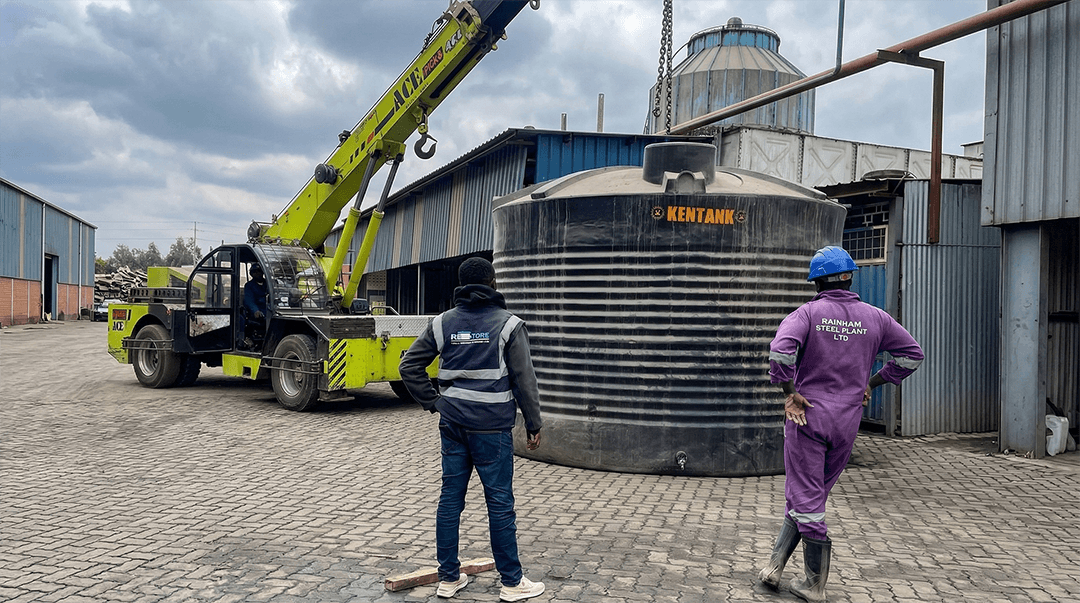
Restore Services specializes in high-capacity tank installations across Kenya, ensuring foundations are sound, plumbing is optimized for flow, and all installations meet local county health regulations. Don't risk structural failure or inadequate pressure.
The Hidden Cost: Maintenance of Large Water Storage
The initial purchase price is just the start. Large tanks require rigorous, scheduled maintenance, which is often more complex than domestic cleaning.
Cleaning Schedule for Commercial Tanks
While domestic tanks might manage a clean every 6-12 months, high-use commercial tanks—especially those storing non-potable water (like cooling tower feed) or those subject to high inflow turbidity—may require cleaning every 3 to 4 months. Sludge build-up in large tanks is significant and requires specialized vacuum equipment, not just a simple brush and hose.
Tip for Factories: If you use water in your manufacturing process, ensure your tank cleaning schedule aligns with planned downtime to avoid production losses. Our professional cleaning teams use environmentally safe biocides (where necessary) and ensure complete sediment removal.
Monitoring and Algae Prevention
In hot, sunny environments like Nairobi or the Coast, algae bloom is a constant threat in tanks that aren't completely opaque or sealed. For very large tanks, look for those with high-quality UV stabilization or consider installing opaque tank covers or painting external surfaces if the tank material allows.
Frequently Asked Questions for Kenyan Commercial Buyers
Q: What is the typical lead time for a 20,000L tank in Kenya?
A: Standard polyethylene tanks are usually readily available from major local distributors. However, custom GRP or specialized steel tanks imported or fabricated locally can take 4 to 8 weeks. Always plan your procurement well ahead of the dry season.
Q: How much should I budget for installation of a 15,000L ground tank?
A: Installation costs vary widely based on location (access difficulties in Nairobi CBD vs. a factory in a new industrial park) and foundation work required. Expect foundation preparation and plumbing hookup to cost between 20% and 40% of the tank purchase price, depending on complexity. Get a detailed quote from a specialist like Restore Services.
Q: Can I use one large tank or is it better to manifold several smaller ones?
A: For redundancy and easier maintenance rotation, manifolding two tanks (e.g., two 10,000L tanks instead of one 20,000L) is often preferable for critical users. This requires careful plumbing design to ensure even draw-down and filling.
Partnering for Water Security
Investing in commercial water storage is a long-term commitment to business continuity. Don't let uncertainty about sizing, installation quality, or material compliance jeopardize your operations. Whether you are upgrading an existing system or planning a brand-new facility, the expertise of a specialized partner makes all the difference.
Restore Services offers end-to-end solutions for Kenya's commercial sector—from initial load calculations and KEBS-compliant sourcing to professional installation and ongoing preventative maintenance contracts. Secure your water future today.