
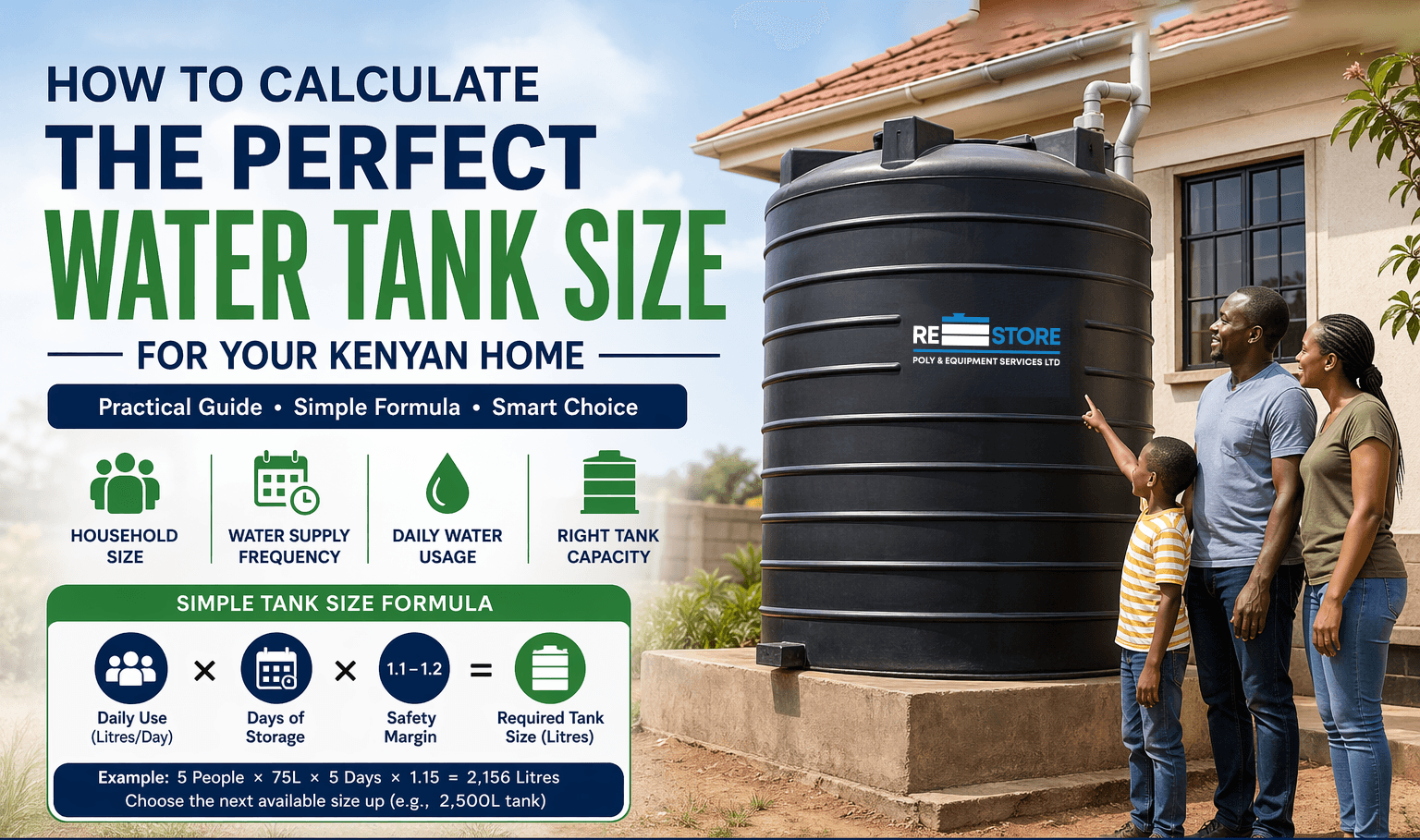
How to Calculate the Right Water Tank Size for Your Kenyan Home
In many parts of Kenya, water supply is not always consistent. Some households receive piped water daily, while others get water only a few times a week. That is why choosing the right water tank size is not just about buying the biggest tank you can afford. It is about matching your storage to your household size, your water supply pattern, and your actual daily use. A well sized tank helps you avoid shortages, reduce emergency refill costs, and plan better for dry periods.
If you are already comparing options, you can also browse our water tank sales page to see available tank buying options and delivery support in Kenya.
Why Accurate Water Tank Sizing Matters
If your tank is too small, you may still run out of water before the next supply day. If it is too large, you may spend more than necessary on purchase, installation, and support base preparation. The goal is to choose a tank that gives you enough buffer without overspending.
- Undersized tank: frequent shortages and expensive emergency refills
- Oversized tank: higher upfront cost and more space required
- Right sized tank: enough storage for your home without wasting money or space
If your current tank is leaking or damaged before you upgrade, you can first check our plastic tank repair services to see whether repair is more cost effective than replacement.
The 4 Main Factors That Determine Tank Size
1. Number of People in the Home
The more people in the household, the more water you need for drinking, cooking, bathing, laundry, cleaning, and sanitation. A practical planning figure for many homes is often 50 to 100 litres per person per day, depending on lifestyle and fixtures.
2. How Often You Receive Water
This is one of the most important questions. Do you get water every day, every two or three days, once a week, or irregularly? Your tank should store enough water to comfortably bridge the gap between supply days.
3. Extra Water Uses
Not all households use water the same way. You may need extra storage if you regularly:
- water a garden or lawn
- wash cars
- run a washing machine frequently
- keep livestock or poultry
- have rental units on the same connection
4. Space, Structure, and Budget
Even if your usage suggests a larger tank, you still need to consider where it will sit, whether the slab or tower can support it, and whether a larger single tank or two connected tanks makes more sense. If you need help setting up a new system, see our water tank installation services.
A Simple Water Tank Size Calculator for Kenyan Homes
You can estimate the right size using this formula:
Tank Size = Daily Household Use × Number of Days You Want to Store Water
Then add a safety margin of about 10% to 20% if your supply is unreliable or your usage changes during dry periods.
Step 1: Estimate Daily Household Use
Use a planning estimate based on your household habits:
- Basic use: 50 litres per person per day
- Moderate use: 75 litres per person per day
- Higher use: 100 litres per person per day or more
Example: A family of 5 using 75 litres per person per day:
5 × 75 = 375 litres per day
Step 2: Multiply by Days of Storage Needed
If that family wants enough water for 5 days:
375 × 5 = 1,875 litres
Step 3: Add a Safety Margin
Add 15% for peace of mind:
1,875 × 1.15 = 2,156 litres
In practice, that household would likely choose the next common tank size up, such as a 2,500 litre tank.
Worked Examples
Example 1: Small Household
2 people, moderate use of 75 litres each per day, 3 day buffer:
2 × 75 × 3 = 450 litres
With safety margin, a 500L to 1,000L tank may work depending on reliability.
Example 2: Medium Family
5 people, moderate use of 75 litres each per day, 5 day buffer:
5 × 75 × 5 = 1,875 litres
With safety margin, a 2,000L to 2,500L tank is a sensible choice.
Example 3: Larger Family With Intermittent Supply
7 people, higher use of 100 litres each per day, 7 day buffer:
7 × 100 × 7 = 4,900 litres
With a safety margin, a 5,000L to 6,000L tank would be more suitable.
Recommended Tank Sizes by Household Type
- 500L to 1,000L: single person, couple, or backup use where supply is frequent
- 1,500L to 2,500L: small families with moderate water use and fairly regular supply
- 3,000L to 5,000L: many family homes in Kenya with intermittent supply
- 6,000L to 10,000L: larger households, compound homes, or homes with gardening and other extra uses
- 10,000L and above: apartments, schools, institutions, commercial sites, farms, or homes with very irregular supply
If you are actively shopping for these sizes, visit our Buy Water Tanks page to explore tank options that match your required capacity.
Should You Buy One Big Tank or Two Smaller Tanks?
In some cases, two tanks can be better than one. Connecting two tanks can make transport and installation easier, allow staged expansion later, and give you flexibility if space is limited. For example, two 2,500L tanks may be easier to handle than one 5,000L tank.
Choosing a Safe and Durable Tank
Tank size is only part of the decision. You should also consider:
- Material quality: choose a tank designed for water storage and suitable for outdoor exposure
- UV resistance: important in Kenya’s sunny climate
- Food grade suitability: important for potable water storage
- Warranty and support: useful if you need fittings, delivery, or future maintenance
After installation, regular cleaning also matters. You can read more about our professional tank cleaning services if you want to keep stored water safer and your tank in better condition over time.
Common Mistakes to Avoid
- Choosing a tank based only on price instead of actual household demand
- Ignoring how often water is supplied in your area
- Forgetting extra uses like laundry, gardening, and tenants
- Installing a tank on an uneven or weak base
- Buying a tank that is too small and planning to manage somehow during rationing
Frequently Asked Questions
How much water does one person use per day?
For planning household tank storage in Kenya, many homes can start with 50 to 100 litres per person per day, depending on lifestyle and fixtures.
Is a 5,000L tank enough for a family home?
In many cases, yes. For a medium sized family with intermittent supply, 5,000 litres can provide a useful buffer. But the right answer depends on your family size, your daily usage, and how many days you need the water to last.
Do I need a bigger tank if I have a borehole?
Not always. If the borehole gives a steady and reliable supply, you may only need moderate storage. If pumping is limited by power, yield, or schedule, a larger tank can still help you store water when pumping is available.
Can a damaged tank be repaired instead of replaced?
In many cases, yes. If the tank has cracks or leaks but is still structurally salvageable, repair may be cheaper than buying a new one. See our frequently asked questions or contact us for an assessment.
Final Takeaway
The best water tank size for your Kenyan home depends on three simple questions:
- How many people use water in the home?
- How much water do you use each day?
- How many days do you need the tank to last?
Once you know those answers, you can estimate your ideal size much more accurately. In many Kenyan households, the sweet spot is often somewhere between 2,000L and 5,000L, but every home is different. The smartest choice is the one that fits your usage, your supply pattern, and your space.
If you are unsure which tank to buy, need installation help, or want advice on whether to repair or replace your current tank, contact Restore Services for guidance.